Trust comes from letting people see you while you’re figuring it out.
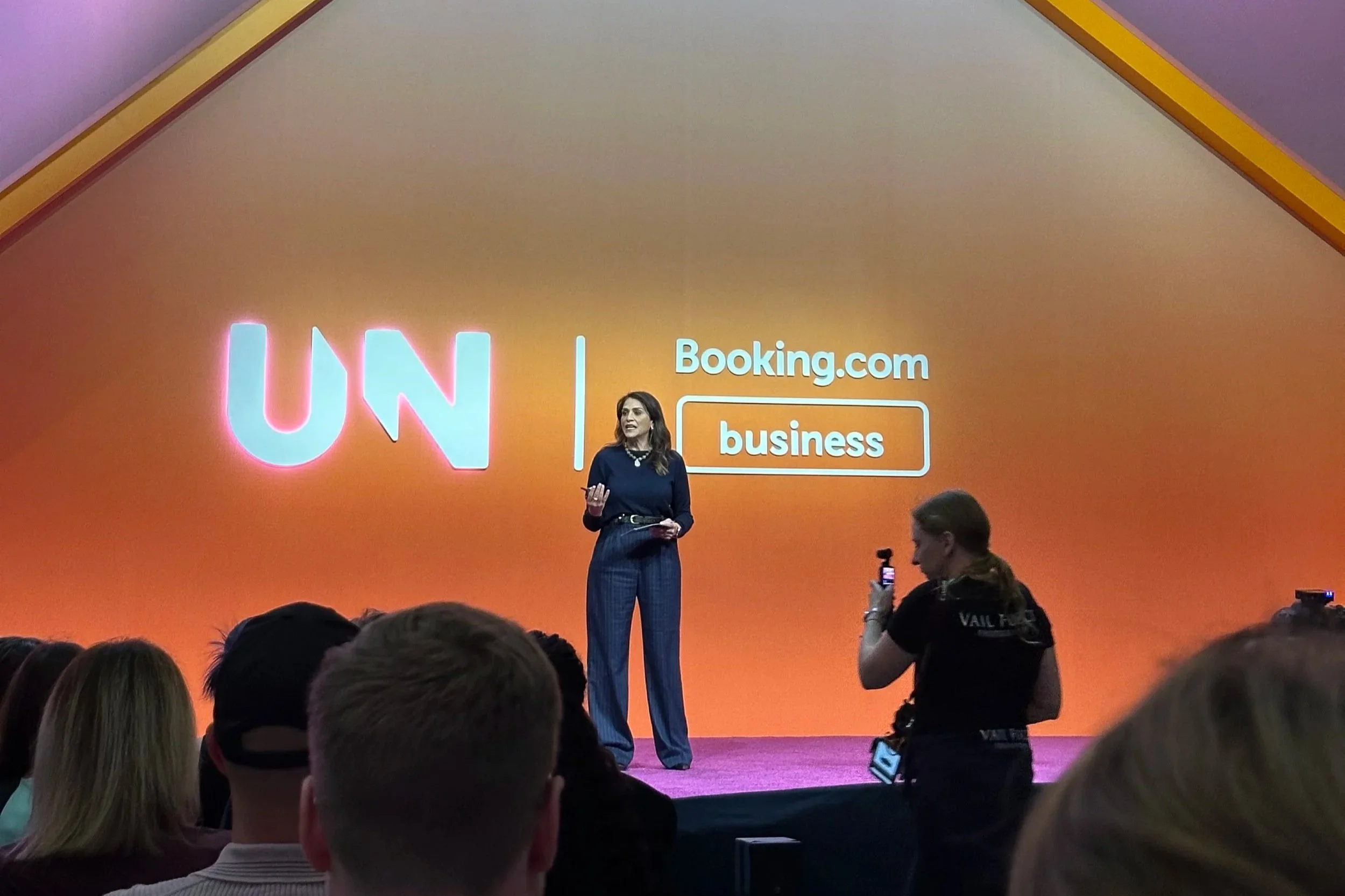
Last week I went to my first-ever work conference: HubSpot UNBOUND.
It was also my first time visiting Boston as a girl who was born and raised in North Carolina. There is nothing that spells imposter syndrome more than that.
More than 13,000 people in a room who have been living and breathing marketing for over a decade and get a dopamine hit from entering a packed show floor, versus me: a recently-turned-23-year-old who has been doing this whole marketing thing for about a year and a half now. (And the first six months don’t count - I was quite literally learning to walk.)
Last week I went to my first-ever work conference: HubSpot UNBOUND.
It was also my first time visiting Boston as a girl who was born and raised in North Carolina. There is nothing that spells imposter syndrome more than that.
More than 13,000 people in a room who have been living and breathing marketing for over a decade and get a dopamine hit from entering a packed show floor, versus me: a recently-turned-23-year-old who has been doing this whole marketing thing for about a year and a half now. (And the first six months don’t count - I was quite literally learning to walk.)
During the last month of my senior year of college, I wrote a blog about the PR and comms characters who raised me: Jenna Rink, Olivia Pope, Andie Anderson, and Carrie Bradshaw. It’s easy to think that those same fictional women would have loved the busyness and hustle-bustle of UNBOUND off the bat.
But the more I think of it, the more I realize that the way they showed up externally was not always how they felt inside.
And we can, and should, feel both things. A lot of the time, at once.
I was excited and eager to attend sessions and hear from people who know much more about CRM data than I do. AND I was intimidated, sweaty, and extremely hesitant to stay behind and speak to them after their thoughtful sessions.
Both were true. And I don’t think it’s far-fetched to say those fictional characters felt that way too, because confidence truly looks different than it feels.
There were many (many many many) moments after sessions ended that I stood around before forcing myself to get in line to “speak to the speaker.” I probably looked much weirder standing to the side staring at the line than I would have just getting in it and then leaving. Nonetheless, I stood and watched.
I constantly found myself thinking about how young I am and how little experience I have. Why would I take up their time speaking about my thoughts on their session without something to give them?
There is something about being one of the youngest people in the room that makes you feel automatically small. But there is a reason you are the youngest person in the room.
Especially in marketing.
Sometimes I feel like my lack of experience (both in work and in life) makes my ideas feel less data-backed. It’s hard to pretend like I know the answers, and I think the point is to be honest about it.
I don’t know the answers, but I am part of the generation the industry is trying to understand. There is a great perspective that can only come from where I am now. And maybe what I have to say isn’t the route we’ll take at work or the idea that will spark millions in sales, but there is still value in saying it.
Maha Abouelenein held a session titled “Building Trust Through Storytelling in a Skeptical World,” and it was my favorite of the week.
She talked a lot about trust and reputation, and how those pieces can be the glue that holds everything together. It felt especially fitting with AI on the rise and maybe coming to wipe us all out. The whole establishing trust thing, in and outside of work, is no easy feat.
But she reminded me that there are so many people out there (and algorithms) that still value the human quirks.
You often hear about major successes from execs or founders, and they detail the lessons learned and mistakes made to get to the top. But when it’s your time to learn those lessons or make the mistakes, sometimes the act of making them doesn’t seem as appreciated as it did when it was done by someone else.
Maybe that’s just me or comes from being new to the game.
The point is you don’t have to be done making the mistakes to start telling the story.
Maha’s session reminded me that the lessons learned contribute to who we are deep down. It is extremely difficult to extend grace to ourselves, especially in a workplace setting where we want to show up polished and perfect all the time. But I really believe sharing stories about our mistakes while you’re experiencing them can be what establishes the most long-lasting and authentic kind of trust.
I left UNBOUND still feeling very much 23 years old. Still new to the workforce. Still going to stand awkwardly to the side of the speaker lines for 20 seconds before deciding I should probably get in it.
But as long as I keep getting in the lines, I think it’s okay.
We don’t have to be perfectly polished and AI-revised before we extend ourselves to something or someone else. Sharing the perspective I have right now will have to be good enough.
Trust comes from letting people see you while you’re figuring it out.
What a scary sentence.
What Losing My Dad and a Pandemic Taught Me About Surrendering
I used to think that if I planned everything just right, life would go the way I wanted. If I studied hard, I’d get the grades. If I showed up for people, they’d always show up for me. If I followed the steps, things would work out. But nothing forces you to rethink control quite like loss.
I used to think that if I planned everything just right, life would go the way I wanted. If I studied hard, I’d get the grades. If I showed up for people, they’d always show up for me. If I followed the steps, things would work out. But nothing forces you to rethink control quite like loss.
At the start of 2020, I was a junior in high school, focused on what felt like normal teenage things—grades, friends, maybe even prom dresses I’d never get to wear. Then, in January, my dad passed away. It wasn’t necessarily sudden, but that didn’t make it any easier. He had spent over a month in the hospital when I was in middle school, waiting for a heart transplant that we knew was his only chance. When he finally got it, we thought that was the turning point—that things would get better. But complications from the surgery and the drastic change in his lifestyle slowly took a toll. By the time we lost him, it felt like we had been bracing for impact for years.
My dad wasn’t just “someone’s dad.” He had a dry, quick wit that could make anyone laugh, and even though he wasn’t the loudest person in the room, you always knew when he was there. He was sharp, observant, and incredibly stubborn in a way that made you both frustrated and secretly admire him. He loved working on projects—fixing things, figuring out how they worked, making them work even when they didn’t want to. He was the best teacher, an even better chef, and when he cared about something, he really cared. That included his family, even if he wasn’t always the best at showing it in the traditional ways. His love was in the small things, the practical things. Like making sure the car was always running right or giving advice in his classic no-nonsense way—short, to the point, but somehow exactly what I needed to hear.
In so many ways, I am just like him. Stubborn, blunt, always pushing forward. But also overly caring and somehow sensitive, even with a hard exterior. For a long time, that similarity scared me—what if I made the same mistakes? What if I carried the same weight he did? But now, I see it as a comfort. A reminder that he’s still with me, in the way I think, the way I react, the way I care. It doesn’t make the loss easier, but it gives me peace knowing that I will always be a reflection of him in some way.
Losing him felt like losing a sense of gravity. And just two months later, the world shut down. What was supposed to be “a week off from school” turned into the rest of my junior year—and then my entire senior year—on Zoom. No prom, no sports, no senior nights. Nothing. It was like life as I knew it just stopped.
At first, I tried to push through, to control what I could. I kept up with schoolwork, stayed busy, and told myself that once things settled down, I’d figure out how to really deal with everything. But the thing about loss—whether it’s a person, a sense of normalcy, or the life you thought you’d have—is that you can’t schedule your way out of it. You can’t plan grief away.
After the initial shock of the pandemic wore off, I started to realize how different everything felt—not just because of what I had lost, but because of how I had lost it. The pandemic was a collective grief, but losing my dad in the months right before made it feel deeply personal. It was like the whole world had entered a period of mourning right alongside me, but in a way that was isolating instead of comforting. People were grieving the loss of “normal,” and I was grieving the loss of him. And because everything was shut down, there was no distraction, no escape. Just me, alone with my thoughts, trying to make sense of a reality that no longer included my dad.
Life after loss is strange. No one tells you how much of grief is about the after—the way it reshapes you, how it sneaks up on you in moments you don’t expect. It’s not just the big things, like birthdays or holidays. It’s the small, stupid things. Seeing a car that looks like his and feeling that split second of recognition before remembering. Wanting to text him about needing a few bucks and realizing I can’t.
Walking across the stage at high school graduation, knowing he should have been there. Getting accepted into UNC-Chapel Hill, his favorite place on earth, and wishing I could tell him first. Thinking about the future—about getting married, walking down the aisle, about the family I’ll have one day that will only know him through stories. Even just walking down Franklin Street, past the building that once held his beloved restaurant, Cypress on the Hill, realizing that I’m living a life he isn’t in.
I overthink a lot. I analyze situations, replay conversations, and imagine scenarios where I could have done something differently. And this hasn't changed (for the better) since losing my dad or living through a pandemic. But I’ve learned (the hard way) that sometimes, the best thing you can do is take a deep breath and let go of the need to fix everything. Some things aren’t meant to be solved. They’re meant to be felt, processed, and eventually, carried forward in a way that doesn’t weigh you down.
I see the world differently now. I pay attention to the details in people—the way they show love in small ways, the way they don’t always say what they mean, the way grief lingers in people’s eyes even when they don’t talk about it. I’ve learned that people carry more than they let on, and that kindness, even in its simplest form, matters more than we realize.
I’m still figuring it all out, and I probably always will be. But if there’s one thing I know now that I didn’t before, it’s that surrendering isn’t the same as being powerless. It’s about trusting that even when things don’t go the way you planned, you’ll still find your way through.
<3
Help, I Feel Everything: The Blessing and Curse of Being an Empath.
Empathy is, without a doubt, my defining trait. It’s also the most exhausting thing about me. I’m the person who absorbs everyone’s emotions like I’m getting paid for it. I can walk into a room and immediately sense if something feels off, even before anyone speaks. I remember people’s tiny quirks, their go-to coffee orders, the random childhood stories they told me once in passing. In a lot of ways, it makes me a great friend. But it also means I carry around a lot of emotional baggage that isn’t even mine.
Empathy is, without a doubt, my defining trait. It’s also the most exhausting thing about me. I’m the person who absorbs everyone’s emotions like I’m getting paid for it. I can walk into a room and immediately sense if something feels off, even before anyone speaks. I remember people’s tiny quirks, their go-to coffee orders, the random childhood stories they told me once in passing. In a lot of ways, it makes me a great friend. But it also means I carry around a lot of emotional baggage that isn’t even mine.
Apparently, this was obvious from the start. When I was four, my grandfather, Lanny Tucker—a psychoanalyst who spent his life studying people’s emotions—told my mom I was an empath. Not in a cute way, but in a “she’s going to have a difficult life” way. He was right. A sad story at bedtime would ruin my night. Another kid crying on the playground meant I was fixing their problem or joining in on the tears. It’s like my brain got wired from birth to treat every emotion within a five-mile radius as something I personally needed to manage.
At its best, my empathy allows me to form real, meaningful connections with people. It’s why I can read between the lines when a friend says “I’m fine” but definitely isn’t fine. It’s why I feel deeply invested in other people’s happiness and go out of my way to do small, thoughtful things—like sending a meme at the exact moment I know they need a laugh or surprising them with that obscure lavender-scented hand soap they casually mentioned two years ago. (Yes, this really happened. Yes, she loved it.)
Empathy also makes me a solid communicator. It’s helped me in class discussions, in group projects, and in any situation where emotional intelligence is key. I’ve always been able to pick up on social cues, adjust my approach, and navigate tricky conversations with a level of understanding that, honestly, sometimes feels like a cheat code.
But then, there’s the downside. The crippling downside.
Empathy means I don’t just understand other people’s feelings—I feel them. All of them. All the time. I cannot watch a video where someone surprises their grandparent without getting misty-eyed. I cannot watch an emotional scene in a show without fully internalizing it. And when it comes to real life? Forget it. If someone I care about is upset, suddenly, I’m upset. But I'll make sure they won't know how upset I am because making them more upset would push me over the edge.
Which brings me to my TikTok problem.
A normal person might watch a video of a baby deer standing alone in a field and think, Oh, cute! I, on the other hand, immediately spiral. Where is its mom? Is it okay? Is someone helping? Is a 'good' person helping? I don’t even wait to find out—I just scroll immediately because I cannot emotionally invest in a potentially tragic deer saga today. (This is also why I have Google searched “Is the dog okay?” before watching certain movies—shoutout to DoesTheDogDie.com for preventing emotional breakdowns since 2010.)
It’s not just TikTok, though. If a friend is having a bad day, I feel like I am having a bad day. If a random person looks sad at the grocery store, I will think about them all day long. One time, I cried at a wedding of someone I hardly knew. They were crying, and my brain was like, Well, guess this is our problem now.
For a long time, I thought this was just who I am. That being an emotional sponge was just the price of being a good, caring person. But I’m learning that there’s a difference between empathy and emotional exhaustion. That just because I can absorb someone else’s feelings doesn’t mean I have to.
I’m trying to set boundaries—something that, for an empath, feels almost impossible. I remind myself that I can care deeply without self-destructing. That I can support my friends without making their struggles my struggles. That sometimes, I need to take a step back and protect my own energy.
And you know what? That’s okay. Actually, it’s necessary.
Because here’s the thing: Empathy isn’t about feeling everything—it’s about feeling with purpose. It’s about knowing when to step in and when to step back. When to help and when to simply listen. When to scroll past the sad deer video and not feel guilty about it.
So yes, empathy is both my best and worst trait. But if learning to manage it means fewer emotional spirals over fictional animals? I’d say that’s progress.